
Zoom
Zoom is the primary web broadcasting platform used at USU. Facilitators help with both IVC classes (which involves Zoom participants as well) and solely web broadcast courses (only Zoom with no IVC system connected). Every student and full-time employee on campus has access to a Zoom account.
Connecting to the Call
For IVC classes, the Zoom call will already be scheduled to connect. Only connect to Zoom on the computer in these circumstances:
- The meeting needs recorded and is not set to automatically record.
- The teacher would like to view the chats or utilize other Zoom features like breakout rooms. Keep in mind that only the students connected to Zoom will have access to those features.
- The teacher would like to view the Zoom participants clearer.
-
Have the instructor go to their Canvas course and access the Zoom integration (found on the left in the navigation menu).
-
Click “Start” next to the correct meeting.
-
While connecting to the call, a pop-up will appear asking to "join with computer audio." Simply close out of that pop-up. If you accidentally do connect to audio, select the arrow next to the microphone in the bottom left hand corner of the Zoom call and select "Leave Computer Audio." If the audio is connected, audio feedback will interfere.
Note: only about 10 Zoom participants will appear in the video layout, as it defaults to active speaker view. If the instructor would like to change that layout to always be equal, start a chat and report that after class. We can adjust the scheduled call so it connects with the requested layout.
Troubleshooting
Each instructor teaching an IVC class had their Zoom calls scheduled for them, as specific settings need to be in place for it to work with the IVC equipment. The settings that should not be changed are:
- Waiting room is off
- Mute on entry is off
- Allow participants to join before the host
- Allow all participants to share content
If a problem arises relating to any of these settings (the room is muted or sharing content doesn't work), view the solutions listed below or start a chat. Please report the problem after class.
Zoom asks for a passcode or host key
Start a chat. The Zoom ID and passcode were scheduled incorrectly or the passcode was changed.
The room is muted
Open Zoom on the computer and "ask to unmute" the IVC participant (labeled as "HiEd_USU_..."). Or start a chat. Make sure to report the problem after class so we can change that Zoom setting.
Sharing content isn't working
Have the instructor open Zoom on the computer. Select the security icon at the bottom of the Zoom call and check the option allowing participants to share content. Report the problem so we can change that Zoom setting.
Some instructors may choose to reserve a classroom to teach their web broadcast class. Web broadcast courses meet purely through Zoom and typically involve all students connecting remotely (no students in the classroom). Some instructors may request a facilitator for their web broadcast course to help with classroom technology (cameras, microphones, etc.) and managing the Zoom meeting (helping with microphone management, assisting with breakout rooms, etc.).
If IVC broadcasts are not involved, teachers will need to schedule their class meetings themselves using Zoom. Find out how to schedule meetings here.
Connecting Without a Codec
- Have the instructor go to their Canvas course and open the Zoom integration (found on the left in the navigation menu).
- Click "Start" next to the correct meeting.
- Once connected to the meeting, make sure the correct sources for the camera and microphone are selected.
- Test the audio sources by selecting the arrow next to the microphone in the bottom left corner of the call and "test microphone and speakers." Zoom will run through the process and help troubleshoot if the incorrect source is selected. Make sure the instructor is using the lapel microphone.
- Adjust the camera in the room to frame the instructor well.
When using an IVC room, the teacher can still just join the call from the computer like a normal face-to-face room. However, you can connect with the codec if:
- The instructor wants you to manage sharing content from the touch panel. This will be most helpful if the teacher is switching between two sources often, like a laptop and PC.
- You want to utilize Presenter Track.
- The student camera wants to be used.
Connecting on a Codec
- Open the Zoom call on the instructor computer like normal.
- Open the Participants side panel and select "Invite."
- Select the "Room System" tab at the top, followed by "Call Out."
- Enter the room's IP address (you will need to get that from us either in a chat or email).
- Leave it on H.323 and click "Call."
Make sure to start the recording on Zoom (saved via the cloud) if the teacher wants the class recorded. Learn more about recordings here.
Connecting to the Call
- Have the instructor go to their Canvas course and open the Zoom integration (found on the left in the navigation menu).
- Click "Start" next to the correct meeting.
- Once connected to the meeting, make sure the correct sources for the camera and microphone are selected.
- Test the audio sources by selecting the arrow next to the microphone in the bottom left corner of the call and "test microphone and speakers." Zoom will run through the process and help troubleshoot if the incorrect source is selected. Make sure the instructor is using the lapel microphone.
- Adjust the camera in the room to frame the instructor well.
Things to Note
- Most non-IVC classrooms do not have student microphones. Crowd mics may be available. If not, teachers need to be aware they will need to repeat the questions and comments of those attending in person for those connected online (if applicable).
- If you need to share the document camera and there isn't an application on the computer for the camera, try sharing through Zoom by going to Share Screen --> Advanced --> Content from Second Camera.
To get acquainted, run through CIDI's website. If you would like additional resources, navigate through the rest of this website and get in touch with Sarah Kohler.
Facilitating Tips
Get added as alternative host
If added as an alternative host, you can connect to the Zoom call on the facilitator computer (without connecting audio) and help with the following Zoom features:
- Manage the waiting room
- Remove participants in the case of zoombombing
- Monitor chats
- Mute and unmute participants
- Start, pause, and stop the recording (it will still be sent to the teacher's account)
- Manage breakout rooms
- Manage polls*
*Only possible if the teacher created the polls before class began.
Get in touch with Sarah Kohler if you would like added as an alternative host.
DTMF Tones - Web broadcast classes
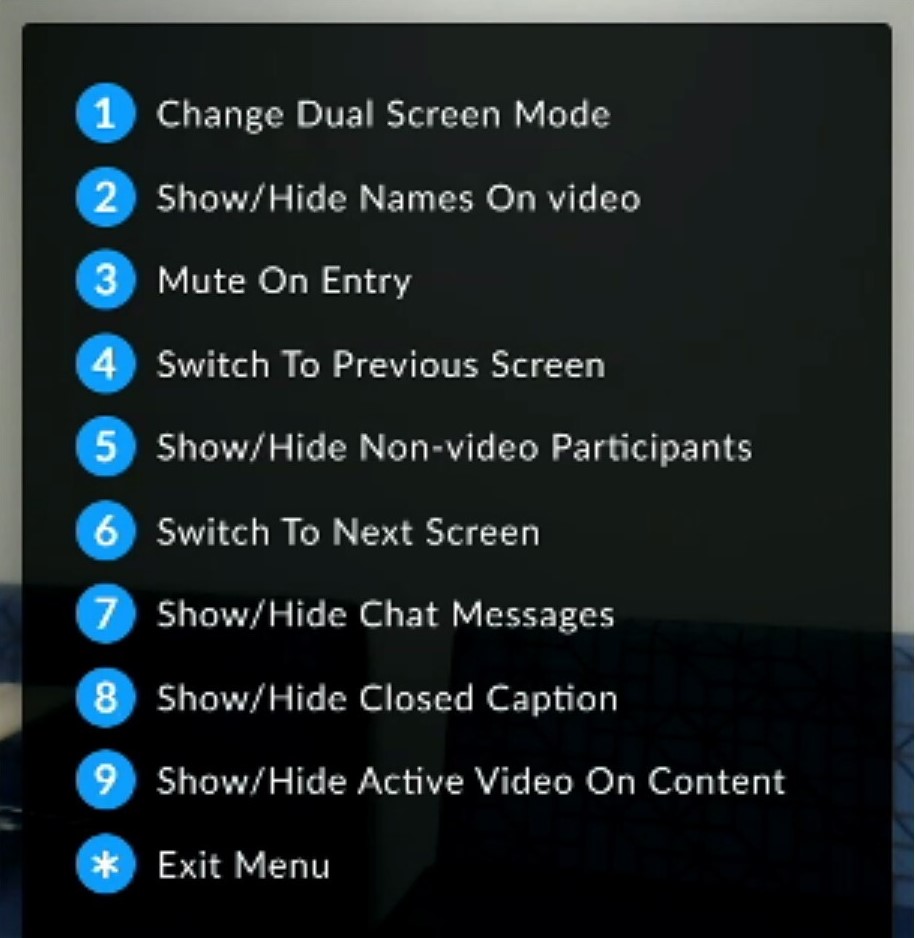
If there are no IVC participants in the call, you can use the DTMF tones from the keypad on the touch panel to control the Zoom call. Changing the layout, muting/unmuting participants, and allowing participants in from the waiting room are a few of the options. Below are images of the menu. View more details about each menu option here.

Dual Monitors
Users can use Zoom across multiple monitors, but the default view creates small floating thumbnails of the participants. By following the steps below, the host will be able to see the full Zoom window with large participants on one screen while their presentation is on the other. If the host would like to see their students larger, follow these steps:
- Open the Zoom desktop application
- Select the settings cog in the top right

- Go to the Share Screen tab on the left
- Check the box next to Show my Zoom windows to other participants when I am screen sharing

Now the same setting needs to be applied to the user's account on the website.
- Open a web browser and sign into zoom.usu.edu
- Select Settings on the left
- Find Show Zoom windows during screen share and turn the toggle on
Troubleshooting
- If features are not available or working as they should, try updating the Zoom application. This is especially important for breakout rooms to function correctly.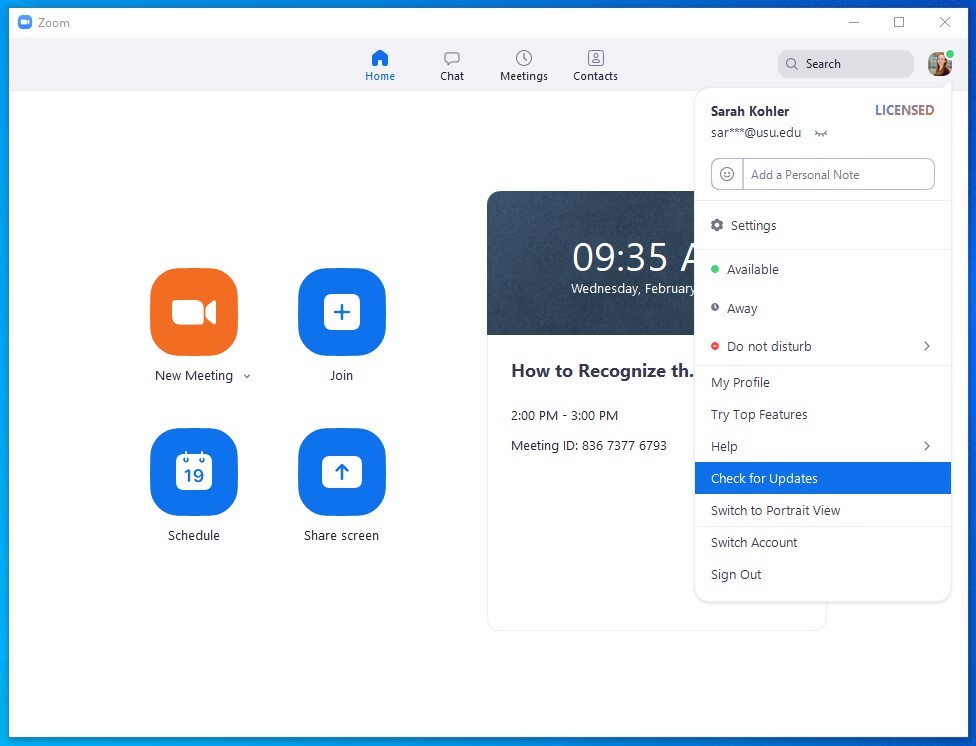
- If the correct person is not being recognized as the host or co-host, make sure they are signed into the USU Zoom account. Sign in through the desktop Zoom client (using the "sign in with SSO" option), then rejoin the call.
Helpful Resources
CIDI's website contains instructions specifically for instructors using Zoom. There are many troubleshooting tips that are helpful for facilitators.
If an instructor would like additional support, you can send them the link to CIDI's website and get them in touch with Sarah Kohler (sarah.kohler@usu.edu).